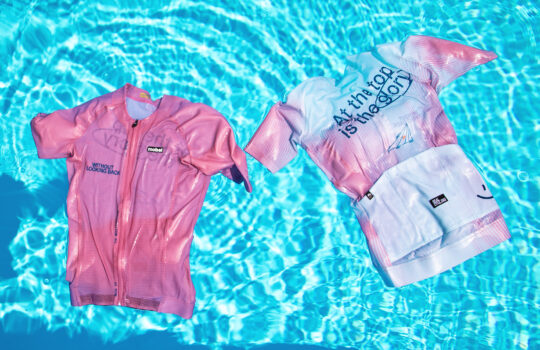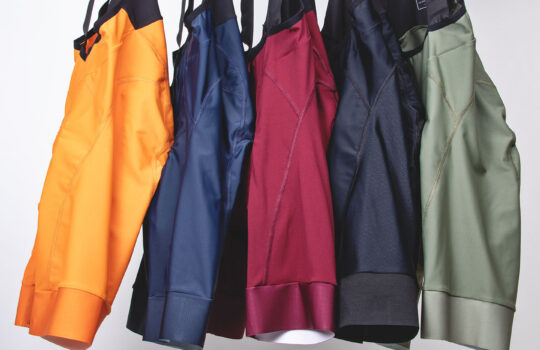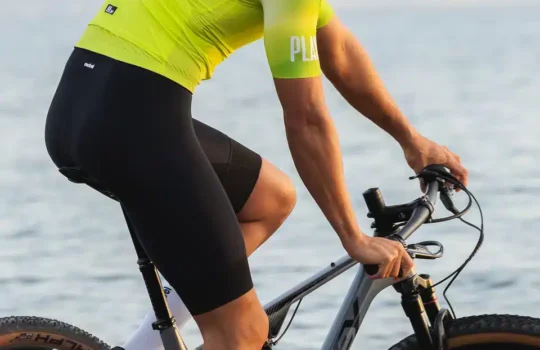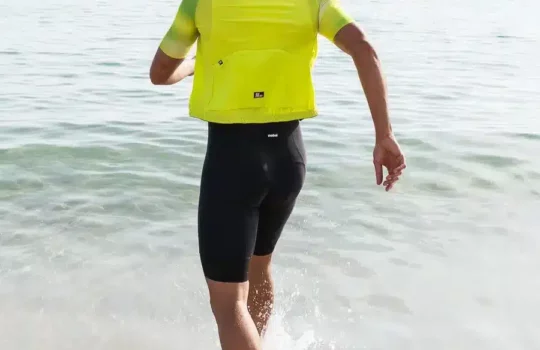


Sportswear with heatable, thermo-regulating and cooling capabilities for improved thermal comfort.

RESEARCH AND INNOVATION> Mobel Sport, in collaboration with AITEX through the Research Group on Smart Textiles and ICT Solutions and the Research Group on Technical Finishes, Health and Biotechnology, has developed a thermoregulable garment for use in different sports with heatable and cooling capabilities that allow physical activities to be carried out in any temperature conditions.
Aim of the project.
Achieving thermal comfort during sporting activities is a very important objective for preventing muscular injuries and promoting recovery and muscular activity. Through the use of heatable fabrics and functional fabrics with cooling properties, this project aims to control the temperature of a sports textile garment to offer users various beneficial properties for the development of their sporting activities. During sporting activities, physical overexertion is produced, which increases body temperature and causes sweating. In these conditions, feeling cool is a pleasant sensation that can be very well received by the user, as well as reducing body temperature. As in the previous example, in cold environments users benefit from warm temperatures on their muscles, both to increase comfort and to avoid injuries.
For these reasons, this project has proposed the creation of a thermoregulable sports garment with heating and cooling capabilities that allows physical activities to be carried out under any temperature conditions by using resistive threads integrated into textile material and functional fabrics with thermoregulating and cooling properties. Throughout the year, in most locations, there is a very large temperature variation that can affect the percentage of physical activity carried out at different times of the year. This development is a solution to allow sportsmen and women not to be held back by bad weather and to continue exercising in spite of the temperatures.
Development and results.
The project has proposed three lines of research, the development and results obtained for each of them have been as follows:
- Heated
In order to comply with the heating properties, technical materials with special properties have been used, such as textile yarns with conductive properties, which are capable of transmitting heat through their fibres. For this purpose, the design of the heatable route that best suits the needs of athletes has been carried out, focusing the application of thermal comfort in the chest and lumbar area. This design has been integrated into the fabric, and at the same time protected to improve the efficiency and safety of the heating system.
Next, the electronics were designed and developed to supply energy to the conductive wires and control the application of thermal comfort. Variables such as current, voltage and electrical resistance had to be adjusted to allow the electronics to function and reach a temperature of 40º.
Finally, a heatable garment has been obtained with three power levels where the athlete can increase his body temperature by 5-10 degrees thanks to the use of resistive wires. The garment is made up of a jersey with conductive threads integrated into the technical fabric, together with control and energy supply electronics of reduced dimensions.


- Refreshing:
To achieve the desired refreshing properties, various materials (microencapsulated refreshing molecules, refreshing finishing products and synthetic polymer gels) have been used, incorporated into the substrates by means of different textile application procedures. Characterising each of the proposed formulations, allowing us to know the state and presence of the products after the application processes, and after use and maintenance, fastness and rubbing tests.
As in the case of the heated line, thermography technology has made it possible to determine the effectiveness, in terms of cooling properties, of each of the formulations applied to the final garments, by means of tests on cyclo-ergometer with real sportsmen and women, being able to determine that temperature reduction values of around two degrees are achieved in different areas of the body between the beginning and end of the tests carried out. In addition, comfort tests have been carried out on the athletes who validated the garments, in order to define in a subjective way the sensation of freshness produced by the developments obtained. These tests have yielded optimum values both on the thermal sensation perception scale and on the increase in comfort offered by the garments during the course of the tests carried out.


- Thermoregulation:
In order to achieve a thermoregulatory effect, phase change microcapsules (PCMs) have been used, for which the type of resin used to anchor them has been a very important aspect to consider, so that there is no chemical interaction between the product and the resin.
Once the ideal formulations had been obtained and applied to the final garments, as in the case of the cooling developments, they were validated with sportsmen and women, obtaining encouraging results, since their objective evaluation indicates that there are no significant differences in the user's sensation, results that were expected since the objective of this line is to maintain stable body temperature.

Project approved by CDTI - Centro para el Desarrollo Tecnológico Industria and co-financed by the European Regional Development Fund (ERDF) through the "Programa operativo de I+D+i".

The Textile Technological Institute AITEX is a technological centre dedicated to research in the fields of knowledge of science and technology that have application in the textile industry. The headquarters are located in Alcoy, a city in Alicante with an industrial and textile tradition, but it also has two Technical Units, one of them in the Technology Park of Valencia, and the other in Onteniente, from where it offers support to these industrial areas. In the international plan, it also has delegations in China, India and Pakistan.